Surface treatment · process selection
Special functional coating · Ni-P-W alloy
Ni-P-W for thin-film resistors
Low temperature-coefficient functional coating
This process deposits a Ni-P-W alloy coating of nickel, phosphorus and tungsten for metal thin-film resistor applications. Selection focuses on a resistivity of about 120 μΩ·cm and a low temperature coefficient of resistance, while also offering corrosion resistance, chemical resistance and bath stability.
Coating resistivity
TCR selection direction
For metal thin-film resistors
Application & structure · conceptual illustration
See how thin-film resistors are used
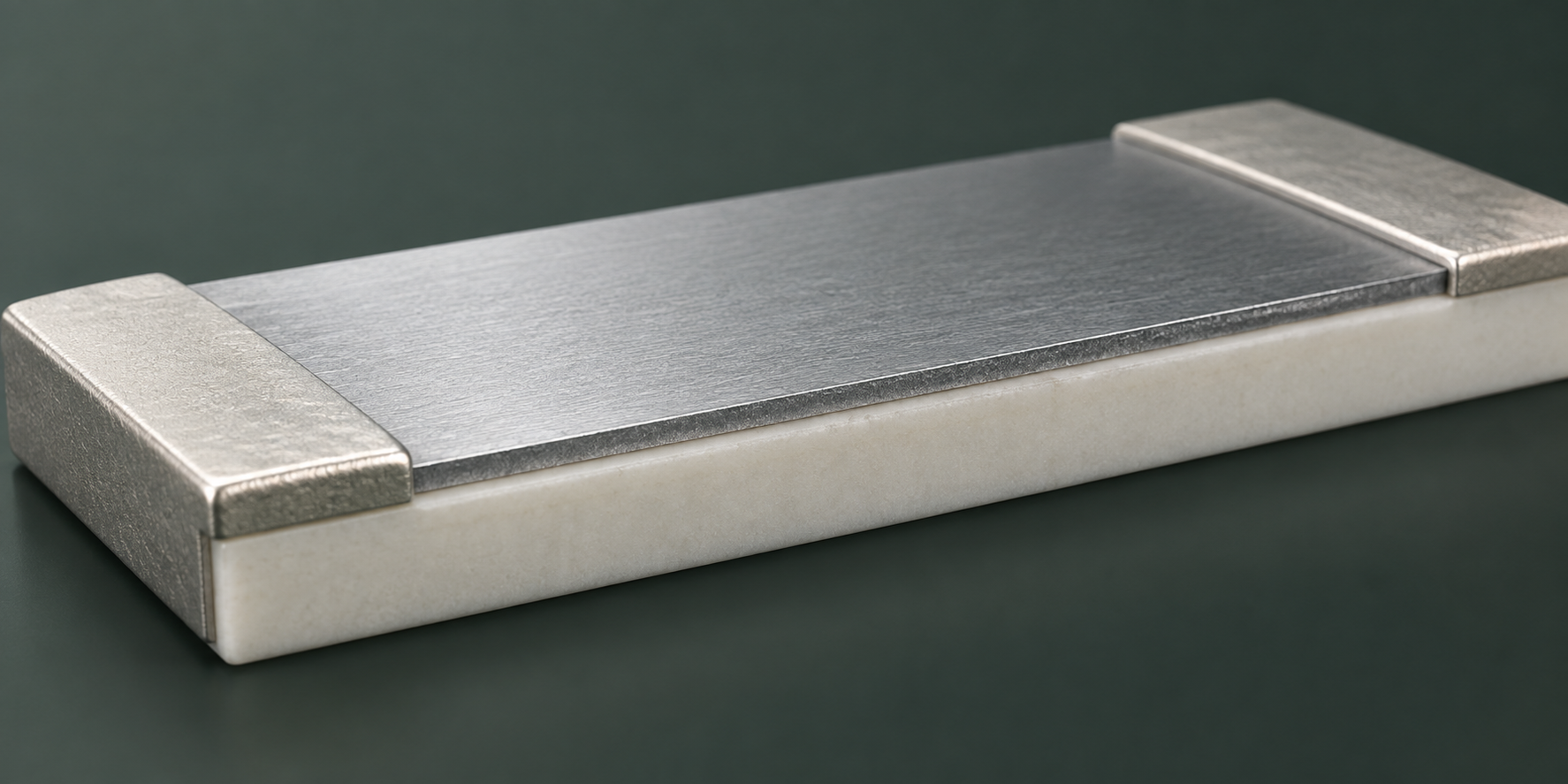
The images below help explain the application and coating structure. Specific substrate, circuit pattern and thickness must be confirmed on the actual workpiece.

1 / Process features
Built around thin-film resistor applications
Evaluated in three aspects: coating electrical properties, service environment and production management.
Resistance performance
Low-TCR coating
For metal thin-film resistors
The Ni-P-W alloy coating has a low temperature coefficient of resistance and can be used for metal thin-film resistors. Verify at selection against target resistance, thickness and operating temperature requirements.
- Resistivity approx. 120 μΩ·cm.
- TCR verified over the operating temperature range.
Low TCREvaluated with the operating temperature range
Service environment
Corrosion and chemical resistance
Evaluated against actual media
The coating has good corrosion and chemical resistance. For specific contact media and service conditions, confirm coating performance on the actual workpiece.
- Corrosion resistance.
- Chemical resistance.
Ni-P-W alloyVerification items set by functional needs
Bath management
Stable, easy to manage
Three-component make-up
The bath is stable and easy to manage. It uses a three-component make-up; the instructions note this avoids problems caused by crystallization in winter.
- Stable bath, easy day-to-day management.
- Bath made up with three components.
6±1 μm/hFresh bath · 90℃ · 1 hour
2 / Performance parameters
Values kept with their conditions
Electrical properties, deposition rate and operating conditions are listed separately to clarify evaluation boundaries.
On narrow screens, swipe left and right to see all parameters →
| Item | Parameter | Conditions & notes |
|---|---|---|
| Coating system | Ni-P-W | Ni-P-W alloy; for metal thin-film resistors |
| Resistivity | approx. 120 μΩ·cm | Coating resistivity given in the instructions |
| Temperature coefficient of resistance | Low TCR | Verified against target operating temperature range, thickness and workpiece structure |
| Corrosion / chemical resistance | Good | Qualitative description from the instructions; corrosion requirements are verified per contact media and service conditions |
| Deposition rate | 6±1 μm/h | Fresh bath, 90℃, 1 hour of plating |
| Operating temperature | 85–95℃ | Operating condition range |
| pH | pH 9.0±0.1 | Measured at 25℃ |
| Nickel sulfate concentration | 19±1 g/L | Nickel sulfate hexahydrate NiSO₄·6H₂O; not the metallic nickel concentration |
- Resistivity is reference data from the instructions; finished resistance and TCR must be confirmed according to actual thickness, workpiece structure and operating temperature range.
- The deposition rate is data under fresh bath, 90℃, 1 hour conditions and cannot be taken as a sustained rate at all operating temperatures or bath ages.
- The above is for process selection and does not replace the full operating instructions.
3 / Application selection
First clarify the resistor requirements
Confirm the process direction by target function, then discuss the actual workpiece with an engineer.
Metal thin-film resistors
Focus on resistivity, TCR and finished resistance requirements.
Evaluation direction: Ni-P-W for thin-film resistors
Discuss substrate, target thickness, target resistance and temperature conditions, and verify on the workpiece.
Other coating needs
Find the right product by function, substrate and coating system.
For neutral low-temperature electroless nickel on glass, ceramics and pottery, see room-temperature electroless nickel.
Selection summary
Evaluate Ni-P-W alloy with resistor function at the core.
Ni-P-W for thin-film resistors targets metal thin-film resistors, focusing on low TCR, resistivity and bath stability. Confirm the appropriate coating solution with the substrate, thickness and working environment.
4 / FAQ
Clarify the system and how parameters are defined
Is Ni-P-W for thin-film resistors low-, mid- or high-phosphorus?
Ni-P-W for thin-film resistors is a Ni-P-W ternary alloy system for thin-film resistor use and is selected as a special functional coating; suitability is confirmed by target resistance, operating temperature range and finished-product verification.
Is resistivity the same as the finished resistance value?
Resistivity describes the electrical property of the coating material; finished resistance also depends on thickness and geometry. Evaluate with workpiece structure, target resistance and temperature requirements.
Confirm a thin-film resistor Ni-P-W solution with an engineer
Please provide the substrate, target resistance, thickness and operating temperature; for parts plating, also specify quantity and drawing requirements.