Processing customers, start here
Improve sliding and start-up behavior
Distinguish dry friction, oil-lubricated or other lubrication environments.
The coefficient of friction depends on the counterpart, load, speed and environment; results from different tests cannot be combined into general upper and lower limits. If you have a friction coefficient target, please provide the test conditions as well.
Tell our engineers your requirements
Enter substrate, quantity and performance targets; if you don't know the specific metrics, you can describe the problem you face.
Detailed test data · expand test conditions, historical data and interpretation
Conclusions first
In the dry sliding chart, PTFE specimens 3 and 2 have lower friction coefficients, applicable only to that group's historical conditions.
The chart has no value labels; the numbers in the table are estimated readings, not original measurement records.
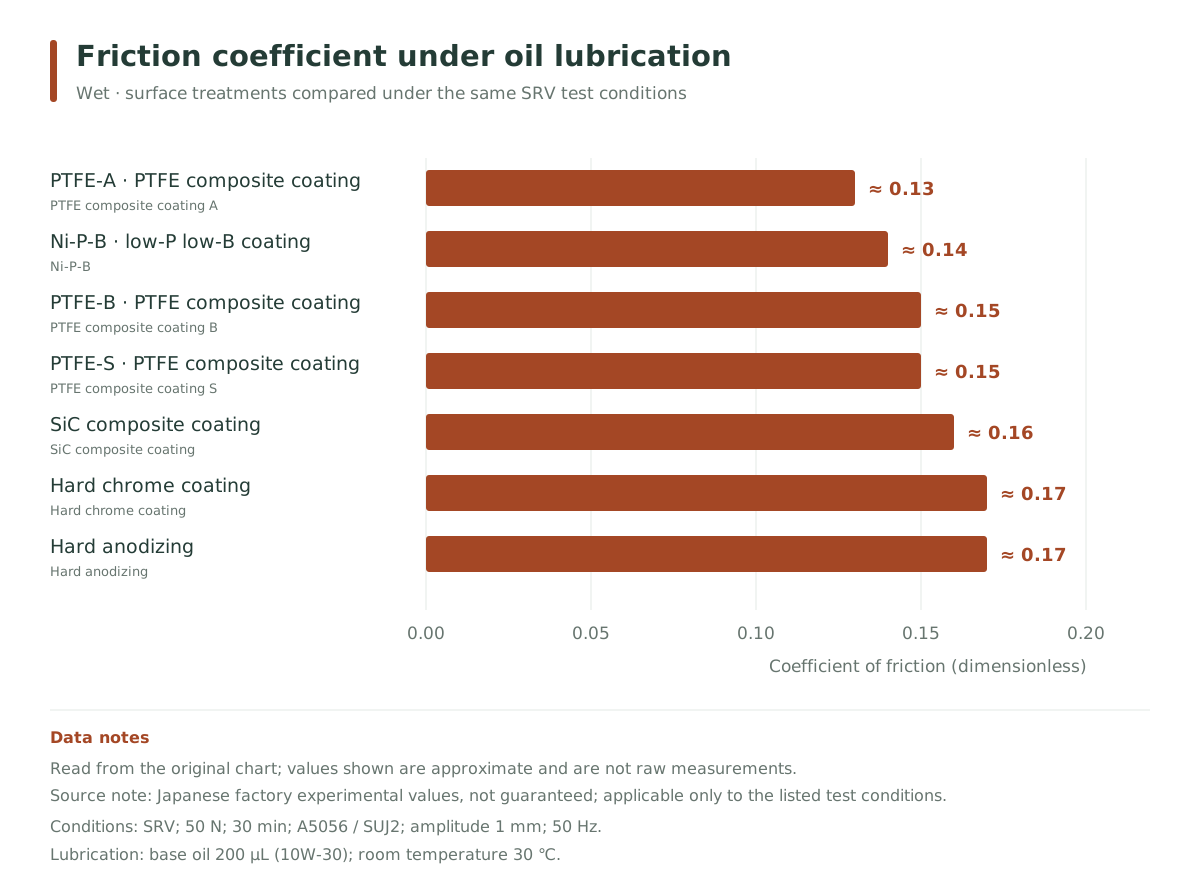
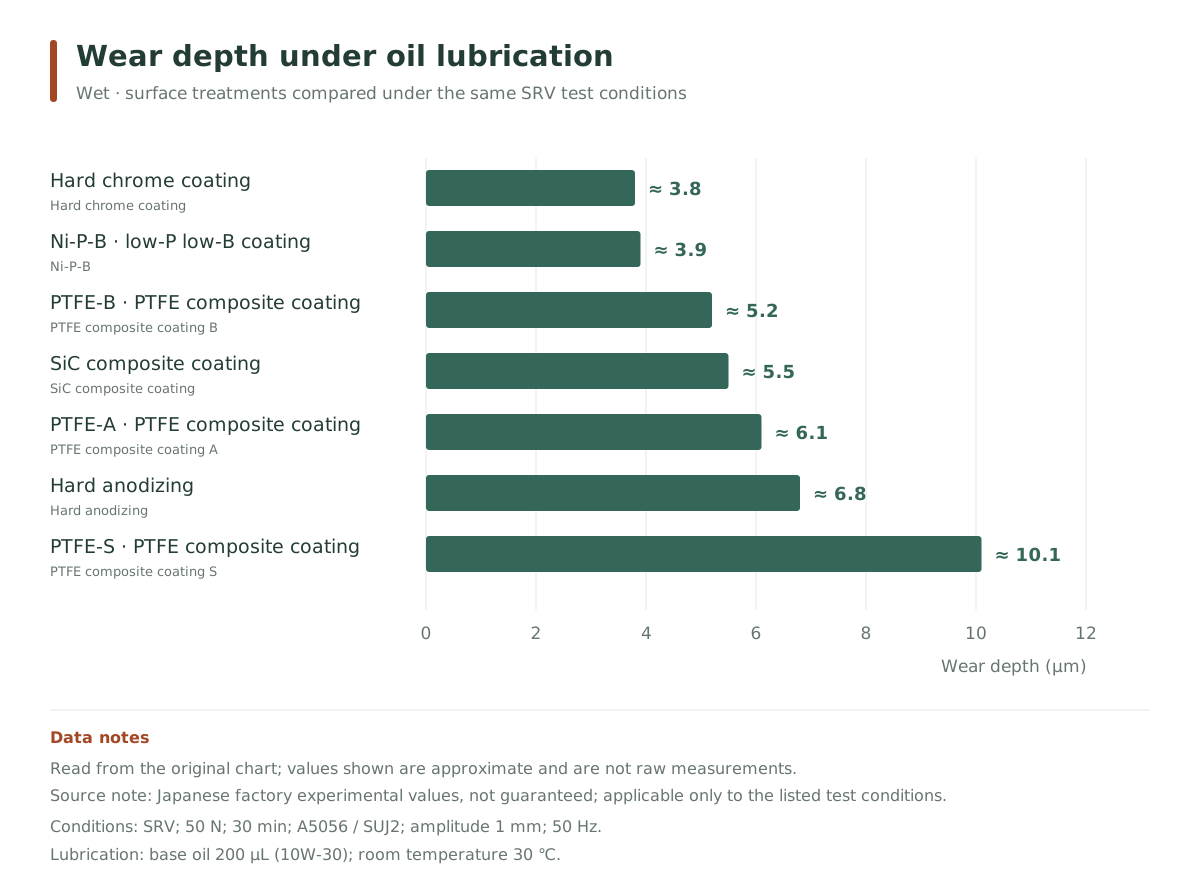
The SRV group uses lubricating oil, i.e. oil-lubricated sliding; it cannot be interpreted as a "humid environment" with only air humidity.
Test conditions
Dry sliding | no lubricant
- Medium
- No lubricant; relative humidity 60%
- Temperature
- 20°C
- Load
- 200 g (load as labeled in source chart)
- Counterpart
- 10 mm diameter alumina ball
Travel speed 100 mm/min; only describes the conditions of this group's dry sliding test.
Oil-lubricated sliding | SRV
- Standard / equipment
- SRV
- Medium
- 200 μL, 10W-30 lubricating oil (as labeled in source)
- Temperature
- Room temperature 30°C
- Load
- 50 N
- Counterpart
- SUJ2
- Substrate
- A5056 (as labeled in source)
Test time 30 min; amplitude 1 mm; frequency 50 Hz. See the SRV oil-lubricated charts on this page for friction coefficient and wear depth; amplitude is not directly the same as full stroke.
Dry sliding friction coefficient · approximate readings from original chart
On mobile, swipe the chart left/right; tap a chart to open the large image.
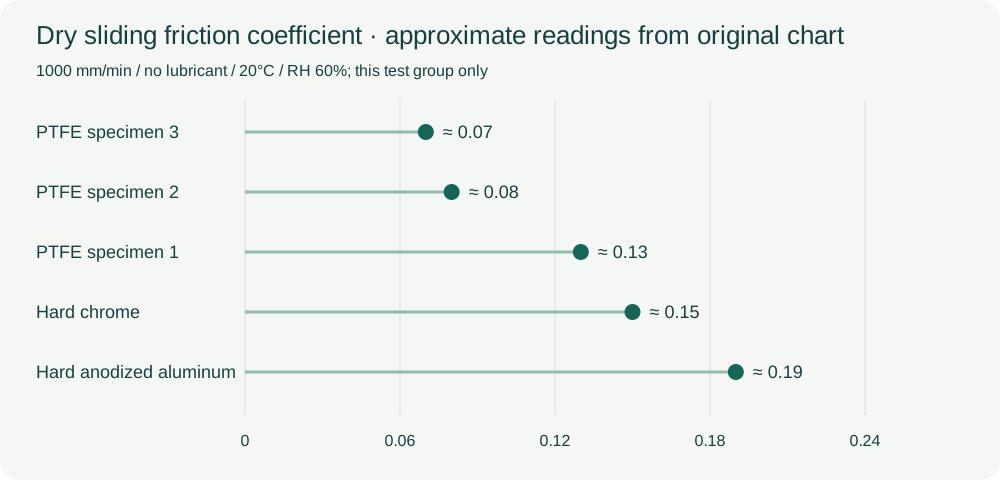
Read from the source bar chart and rounded to two decimal places; this precision is not the instrument's measurement precision. A lower coefficient means relatively lower frictional resistance under this group's conditions. Load 200 g, counterpart a 10 mm diameter alumina ball. The numbers are only for comparison within this historical test and cannot be applied to the oil-lubricated SRV test.
Horizontal axis: coefficient of friction μ (dimensionless). Each point corresponds to a record in the original data table below; see the test data on the same page for applicable conditions.
Data & interpretation
Dry sliding friction coefficient | chart readings
The table scrolls horizontally; the first column keeps the comparison items.
| Surface treatment | Coefficient of friction μ (dimensionless, approx.) |
|---|---|
| PTFE specimen 3 | ≈ 0.07 |
| PTFE specimen 2 | ≈ 0.08 |
| PTFE specimen 1 | ≈ 0.13 |
| Hard chrome | ≈ 0.15 |
| Hard anodized aluminum | ≈ 0.19 |
Read from the source bar chart and rounded to two decimal places; this precision is not the instrument's measurement precision. A lower coefficient means relatively lower frictional resistance under this group's conditions. Load 200 g, counterpart a 10 mm diameter alumina ball. The numbers are only for comparison within this historical test and cannot be applied to the oil-lubricated SRV test.
Test charts & test conditions
View charts, methods and conditions test by test. Vector charts can be clicked to enlarge; each data group applies only to the corresponding specimens and test conditions.
SRV oil lubrication: friction coefficient & wear depth
Test method & conditions
- Test equipment
- SRV
- Load / frequency
- 50 N / 50 Hz
- Time / amplitude
- 30 min / 1 mm
- Coated substrate / counterpart
- A5056 / SUJ2
- Lubricant
- 10W-30 base oil, 200 μL
- Temperature
- Room temperature 30 ℃
Japanese factory test values, not guaranteed values. Bar lengths are read from the original charts and values are approximate; they apply only to the listed test conditions.
Source
Dry friction: test setup & conditions
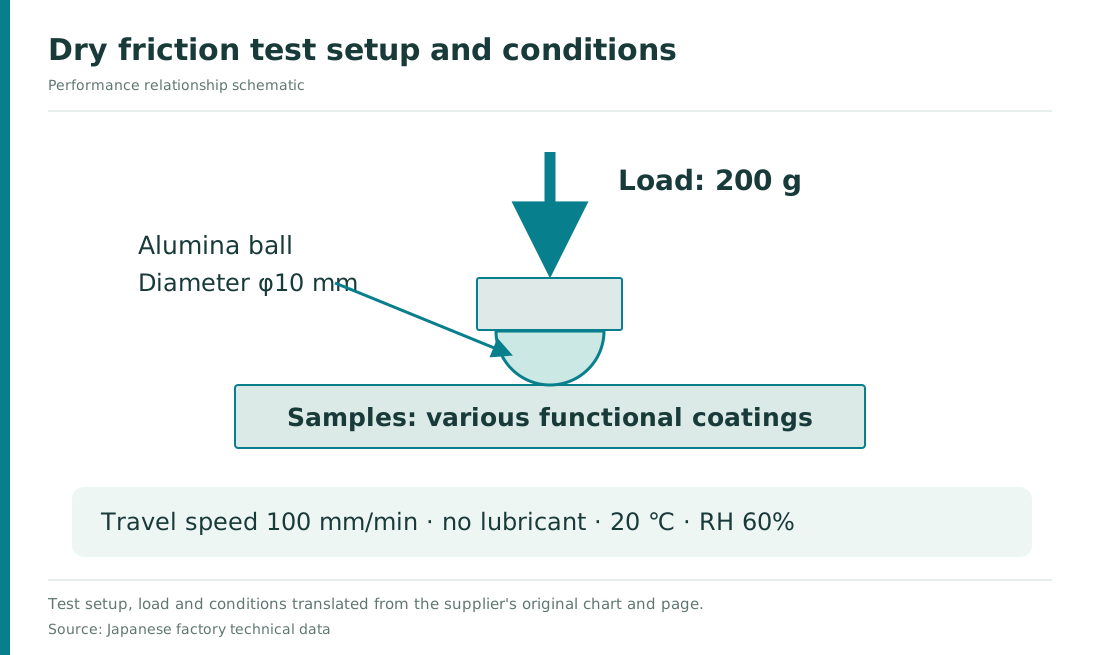
Test method & conditions
- Counterpart / load
- 10 mm diameter alumina ball / 200 g
- Travel speed
- 100 mm/min
- Environment
- No lubricant; 20 ℃; relative humidity 60%
The existing dry friction curve on this page continues to be used; above is the corresponding setup description for that group. Dry and SRV oil-lubricated tests are different tests.
Source
Selection advice & data boundaries
When choosing a coating, please also provide the motion type, counterpart material, contact pressure, speed and lubrication method. Friction coefficient and wear life should be verified separately.
PTFE specimens 1, 2 and 3 in the table only distinguish samples in this historical test; please request technical documents to confirm the specific processes and corresponding parameters.