Surface treatment · process selection
Electroless nickel plating · Ni-P alloy
Mid-phosphorus electroless nickel
From electronics manufacturing to general parts, choose the coating by application.
Mid-P electroless nickel is based on a Ni-P alloy coating, meeting functional needs such as wear and corrosion resistance. This page keeps five base options—electronics, general balanced, aluminum-compatible, bright general-purpose and low-nickel general—plus the temperature-adjustable type. Select by substrate, target phosphorus content and line conditions.
Five base options and the temperature-adjustable type
Parameters keep temperature and test conditions
With thickness, pretreatment and service environment
Test charts & test conditions
Reference charts on heat treatment and surface condition of general electroless nickel, independent of the parameters of the chemicals on this page. The charts show test trends; specific products are selected per their corresponding process and test conditions.
General electroless nickel: heat-treatment temperature vs. hardness
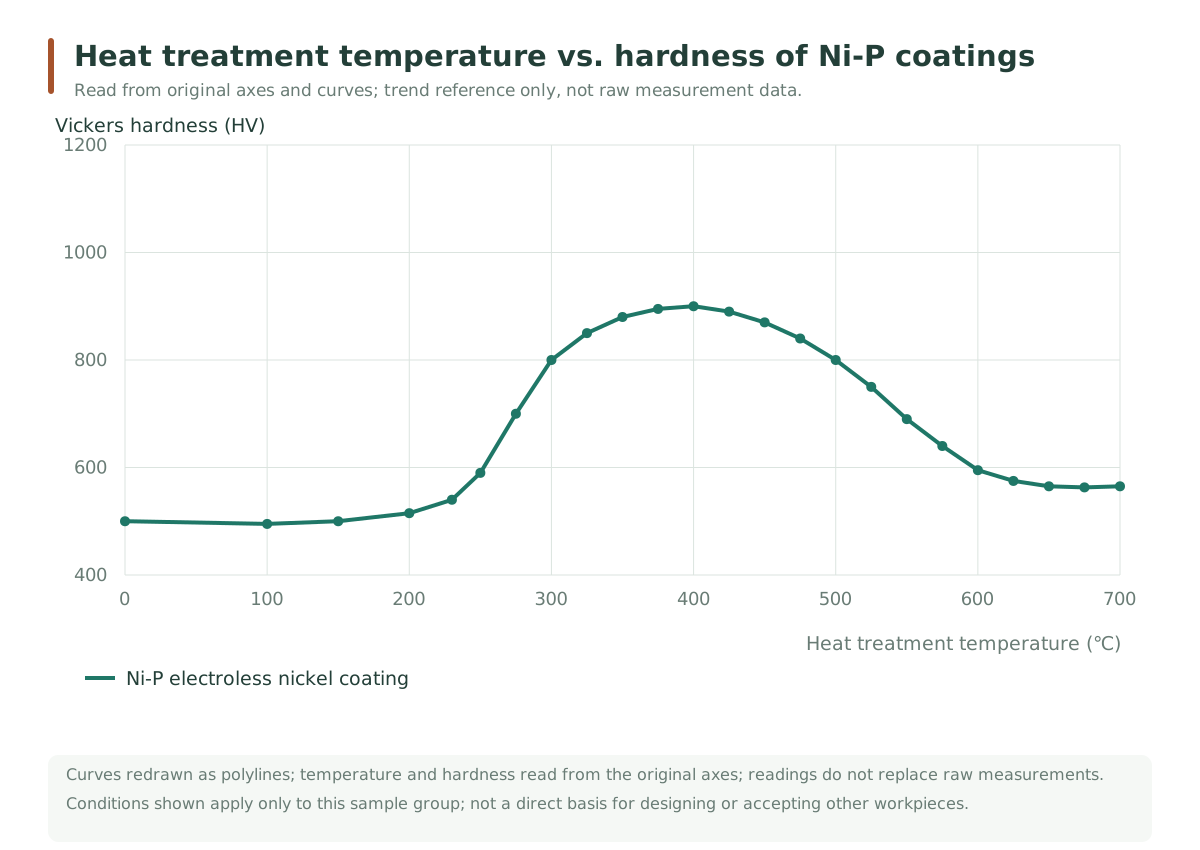
Test method & conditions
- Specimen
- General electroless nickel Ni-P
- Heat-treatment temperature
- Horizontal axis 0–700 ℃, see chart
Japanese factory test values, not guaranteed values. The curve is read from the original chart to illustrate the heat-treatment trend; it cannot be used directly as an acceptance curve for current products.
Surface roughness before and after plating
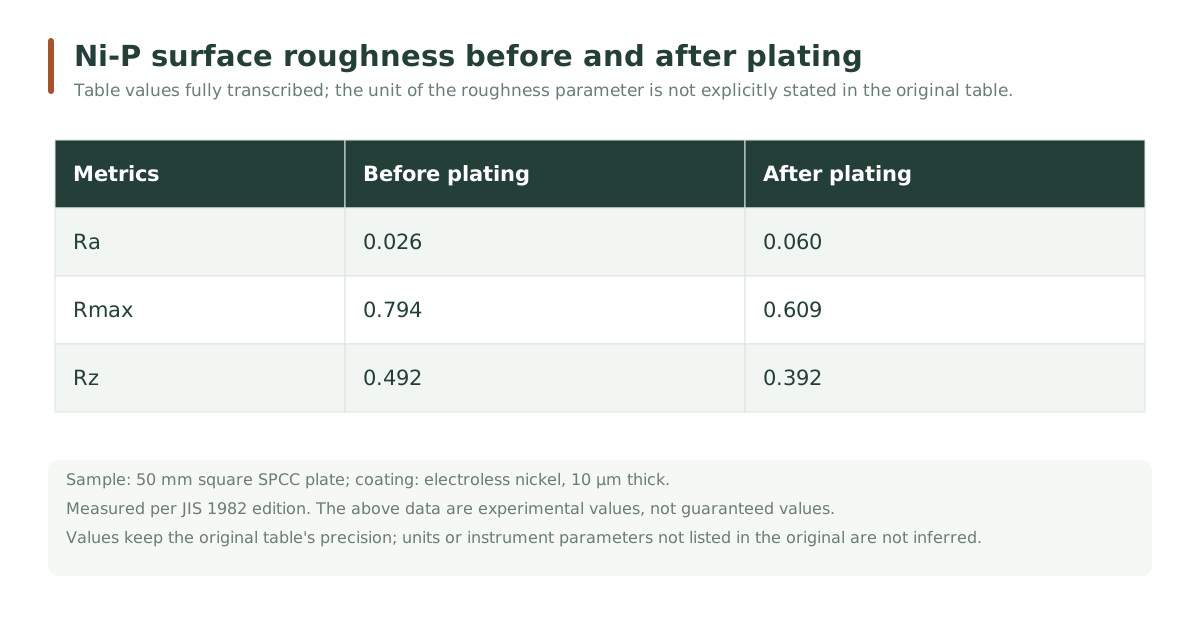
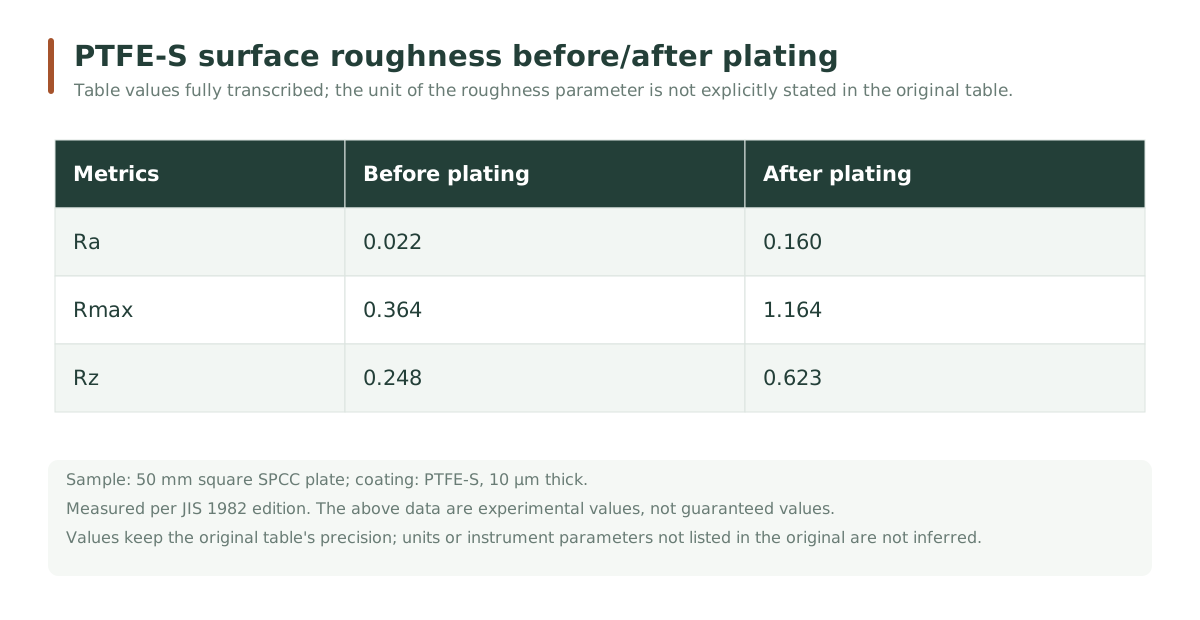
Test method & conditions
- Source standard as cited
- JIS 1982 edition (as cited by source)
- Substrate
- 50 × 50 mm SPCC plate
- Coating / thickness
- General electroless nickel Ni-P / PTFE-S composite coating; both 10 μm
- Metrics
- Ra, Rmax, Rz (for comparison with the original table only, not for specification judgment)
Japanese factory test data, not guaranteed values. Original table values are only for comparing surface conditions within the same group and are not used to specify roughness limits. PTFE-S refers to the source's S-series composite coating.
1 / Process options
Five base options for different needs
Understand process differences by application direction, then move on to parameter comparison.
Electronics industry
Electronics type
Focus on appearance and quality stability in continuous production
For electroless nickel needs of electronics industry parts, balancing corrosion, wear and chemical resistance. Gloss remains stable during continuous use, suiting production focused on batch appearance consistency and bath management.
- Coating phosphorus content 5%–9% (mass fraction).
- As-plated hardness approx. 450–550 HV.
- The instructions state that gloss remains stable during continuous use.
- Supports automatic analysis and replenishment for continuous production management.
16±2 μm/hFresh bath · 90℃
General parts
General balanced type
Balancing functional coating and daily production management
For surface treatment of general parts, balancing corrosion, wear and chemical resistance. The bath is stable and easy to manage, compatible with automatic analysis and replenishment, suiting production that requires ongoing coating quality control.
- Coating phosphorus content 8%–10% (mass fraction).
- As-plated hardness approx. 500 HV.
- Balances corrosion, wear and chemical resistance.
- Two-component make-up, supports automatic analysis and replenishment.
18±2 μm/hFresh bath · 90℃
Aluminum & aluminum alloy parts
Aluminum-compatible type
For aluminum parts, balancing coating performance and line stability
For aluminum part surface treatment, the coating combines corrosion, wear and chemical resistance. Lead-free formulation, stable and easy-to-manage bath, compatible with automatic analysis and replenishment. Selection for aluminum parts must be verified with the alloy series, pretreatment and actual workpieces.
- Coating phosphorus content 6%–9% (mass fraction).
- As-plated hardness 500 HV.
- Lead-free formulation, meeting functional coating needs.
- Supports automatic analysis and replenishment for continuous production control.
18±2 μm/hFresh bath · 86℃
Multiple substrates · bright appearance
Bright general-purpose type
Balancing appearance, wear resistance and multi-substrate use
Suitable for substrates such as aluminum alloys, stainless steel, carbon steel, alloy steel and copper alloys. The coating is bright, meeting both functional and decorative needs; the instructions give as-plated hardness, heat-treated hardness and salt spray data under specified conditions, for evaluation against target performance.
- Coating phosphorus content 5%–8% (mass fraction).
- As-plated hardness approx. 500 HV; 750 HV after heat treatment at 280℃ for 1 hour.
- Lead- and cadmium-free formulation, suitable for various metal substrates.
5%–8%coating phosphorus content · mass fraction
Barrel plating · thin coatings · high drag-out workpieces
Low-nickel general type
Lower bath nickel concentration to address drag-out loss management
Suitable for general electroless nickel applications, especially barrel plating, thin coatings and complex workpieces that easily trap solution. Lower metallic nickel and hypophosphite concentrations help reduce chemical drag-out loss for the same drag-out volume, while also offering bright appearance, coating uniformity, and wear and corrosion resistance.
- Bath metallic nickel concentration 2.4–3.4 g/L, typical 3.0 g/L.
- Coating phosphorus content remains 5%–8%, a mid-P coating.
- As-plated hardness approx. 500 HV.
- Lead- and cadmium-free formulation, focusing on chemical utilization and continuous production management.
3.0 g/Lbath metallic nickel concentration · typical
Supplementary process / temperature-adjustable type
Temperature-adjustable type
Temperature-adjustable electroless nickel · mid-P to high-P range
Under the test conditions given in the data, temperature changes affect plating rate, coating phosphorus content and internal stress at the same time. When selecting, confirm the target composition together with the production temperature.
Phosphorus content · approximate reading from original curve
Test temperature range of the technical data
Heat treatment condition in the hardness chart
Selected per this site's existing classification
Spans the mid-P and high-P ranges; confirmed per operating conditions.
This site's existing classification is mid-P 5–10% and high-P 10–13%. The temperature-adjustable type is charted at about 9–10.5 wt%, spanning the boundary; this page presents the full process, and the high-P page keeps a corresponding entry. Conditions near or above 10% should have the actual coating composition confirmed separately; not all test temperatures can be treated as high-P conditions.
Temperature linked with plating rate and phosphorus content
In the same group of curves, raising temperature increases plating rate and lowers coating phosphorus content.
Define the target composition first, then evaluate plating rate
Test conditions are pH 6.00, nickel sulfate 25.0 g/L, 70–90℃; the temperature range is the test window.
Internal stress varies with temperature
The original chart shows internal stress decreasing with rising temperature.
Pay attention to stress and dimensional requirements
This result reflects the test conditions in the data and does not indicate zero stress or a uniform stress level for all workpieces.
Hardness increases after heat treatment
The original chart compares as-plated hardness with hardness after 300℃ × 1 h heat treatment.
Evaluate together with heat treatment conditions
Charted at about 500 HV as-plated and 900 HV after heat treatment; approximate curve readings.
| Item | Data record | Applicable conditions / notes |
|---|---|---|
| Coating phosphorus content | approx. 9–10.5 wt% | Approximate reading from the temperature–phosphorus curve; varies with temperature, not a fixed composition specification. |
| Test temperature | 70–90℃ | The data's test window for temperature effects. |
| pH / nickel sulfate | 6.00 / 25.0 g/L | Common test conditions listed for the same group of curves. |
| Plating rate / internal stress | Rising temperature increases plating rate and lowers internal stress | Shown per the original chart's trend; not extended into production guarantees. |
| As-plated hardness | approx. 500 HV | Approximate reading from the original hardness curve. |
| Hardness after heat treatment | approx. 900 HV | 300℃ × 1 h; approximate reading from the original hardness curve. Specimen SPCC, thickness 15 μm; load 50 g, dwell 10 seconds. |
Based on pp.2–5 of the temperature-adjustable type technical data (2008.01). The curves show the trends of this test group; actual workpieces are confirmed by target phosphorus content, temperature and coating performance.
2 / Performance comparison
Performance comparison
Compare disclosed data while keeping the applicable conditions of each item.
On narrow screens, swipe left and right to see all five options →
| Comparison item | Electronics type | General balanced type | Aluminum-compatible type | Bright general-purpose type | Low-nickel general type |
|---|---|---|---|---|---|
| Selection focus | Electronics industryStable appearance & continuous production | General partsFunction & easy management | Aluminum partsAlloy & pretreatment compatibility | Multi-substrate general useBright appearance with function | General & high drag-out scenariosLower bath nickel concentration |
| Coating phosphorus content | 5%–9%mass fraction | 8%–10%mass fraction | 6%–9%mass fraction | 5%–8%mass fraction | 5%–8%mass fraction |
| As-plated hardness | approx. 450–550 HVnot heat-treated | approx. 500 HVnot heat-treated | 500 HVnot heat-treated | approx. 500 HVnot heat-treated | approx. 500 HVnot heat-treated |
| Corrosion performance | Good | Good | Good | Salt spray 100 hCarbon steel, thickness 25.4 μm, ASTM B117 | Aluminum alloy 96 h; carbon steel >96 h2024 aluminum alloy / 1010 carbon steel flat panels; thickness 25.4 μm, time to first corrosion spot, ASTM B117 |
| Wear performance | Good | Good | Good | Good | 13–16 mg/1000 cyclesAs-plated, Taber abrasion weight loss; 11–13 mg/1000 cycles after 345℃ × 1 hour |
| Deposition rate | 16±2 μm/hFresh bath, 90℃ | 18±2 μm/hFresh bath, 90℃ | 18±2 μm/hFresh bath, 86℃ | 10–20 μm/h89℃ | 13–20 μm/h90℃ |
- Heat treatment reference: bright general-purpose type 750 HV (280℃ × 1 hour); low-nickel general type 900–950 HK100 (370℃ × 1 hour; steel, thickness 76.2 μm, 100 g load). Each corresponds to its own process and specimens.
- Deposition rates have been checked against each original instruction document, keeping the full range with the corresponding temperature and fresh-bath conditions. The upper limit of a range does not represent a sustained mass-production rate or an on-site guarantee; data under different temperatures, bath ages and formulations cannot be used directly to rank production efficiency.
- HV is Vickers hardness; HK100 denotes Knoop hardness with the corresponding test load. Test methods, thickness and heat treatment conditions differ, so values cannot be ranked directly. Taber abrasion data is only a reference for the corresponding process; agree on wheel type and test load before acceptance.
- The bright general-purpose type's salt spray data is the instruction result on carbon steel at a specified thickness; the low-nickel general type's is the time to first corrosion spot on specified flat panels at 35℃, 5% NaCl. Substrates, thicknesses and judging criteria differ between tests, so they cannot be ranked directly or converted into actual service life.
- Phosphorus content and as-plated hardness of the electronics, general balanced and aluminum-compatible types, and as-plated hardness of the low-nickel general type, use confirmed parameters. Actual results depend on substrate, pretreatment, thickness and bath management.
3 / Application selection
Summary by industry and production scenario
First define your most important need, then choose the evaluation direction.
Electronics manufacturing
Focus on coating appearance, batch stability and subsequent assembly requirements.
Evaluate first: electronics type
Where soldering, electrical contact or special reliability requirements are involved, verify separately on the actual structure.
Machinery & general parts
Focus on wear and corrosion resistance and process management in continuous production.
Evaluate first: general balanced type; for a bright appearance as well, evaluate the bright general-purpose type
Determine the solution with substrate, coating thickness, friction conditions and service media.
Aluminum processing & aluminum alloy parts
Focus on alloy series, pretreatment integration and finished coating performance.
Evaluate first: aluminum-compatible type
The bright general-purpose type also lists aluminum alloys in its scope and can be evaluated additionally according to appearance and performance targets.
General barrel plating, thin coatings & high drag-out workpieces
Focus on chemical drag-out loss, metal utilization and mass-production cost.
Evaluate first: low-nickel general type
The actual economic benefit of a low bath nickel concentration should be calculated with drag-out volume, replenishment amount and yield.
Selection summary
Choose the right mid-P process around your application.
Electronics applications value stability, general parts balance performance, aluminum parts prioritize compatibility, bright needs are chosen with multiple substrates in mind, and high drag-out scenarios focus on the low-nickel process. Let the application set the direction and actual workpieces verify the result.
Process condition referenceExpand to see temperature, pH and bath concentration
The following are typical values or working ranges from each set of instructions and must be used together with the corresponding process requirements.
| Comparison item | Electronics type | General balanced type | Aluminum-compatible type | Bright general-purpose type | Low-nickel general type |
|---|---|---|---|---|---|
| Temperature | 85–95℃ | 85–95℃ | 85–95℃operating conditions table | typical 89℃typical production temperature | 88–91℃typical 89℃ |
| pH | 4.70±0.05 | 4.80±0.05 | 4.6±0.3working range | typical 4.9aluminum part conditions confirmed separately | typical 5.0daily management reference 4.9–5.2 |
| Bath nickel concentration | 22.5±1 g/Lnickel sulfate hexahydrate; metallic nickel at make-up approx. 5.02 g/L | 24±1 g/Lnickel sulfate hexahydrate | 5.6±0.5 g/Lmetallic nickel | 4.9–6.4 g/Lmetallic nickel; typical 6.0 g/L | 2.4–3.4 g/Lmetallic nickel; typical 3.0 g/L |
- The temperature range in the bright general-purpose type instructions is inconsistent with the upper-limit requirement later in the document, so this page keeps only the commonly stated typical temperature of 89℃; aluminum part pH must also be confirmed together with the complete process conditions for that substrate.
- The low-nickel general type parameter table gives pH 4.9–5.3, while the maintenance section's usual range is 4.9–5.2. This page shows the typical value of 5.0 and the maintenance range.
- Nickel sulfate hexahydrate concentration and metallic nickel concentration are different bases; values in the table cannot be divided and compared directly. The above is a selection reference, not a complete bath make-up or production operating procedure.
4 / FAQ
Before selecting, understand these differences
Is low-nickel the same as low-phosphorus?
No. "Low-nickel" describes the metallic nickel concentration in the working bath; "mid-P" describes the phosphorus content in the deposited coating. The low-nickel general type has a typical bath metallic nickel concentration of 3.0 g/L, while coating phosphorus content is still 5%–8%.
Why do the options have different phosphorus ranges?
Each process has its own phosphorus range: 5%–9% for the electronics type, 8%–10% for the general balanced type and 6%–9% for the aluminum-compatible type—these three use supplementary parameters; the bright general-purpose and low-nickel general types are listed at 5%–8% per their instructions. This page keeps each process's data and applicable conditions separately. The supplementary temperature-adjustable type is charted at about 9–10.5 wt%, spanning the mid-P and high-P ranges, and is listed separately with its test conditions.
Which option has the best overall performance?
Start with the application requirements. The electronics industry focuses on continuous production and stable appearance; general parts balance wear and corrosion resistance; aluminum parts focus on alloy and pretreatment compatibility; the bright general-purpose type balances multiple substrates and appearance; the low-nickel general type emphasizes lower bath nickel concentration and drag-out loss management. Only verification with actual workpieces at the target thickness and conditions can determine the right option.
Special functions & substrates
Continue exploring other systems by application.
Ni-P-W for thin-film resistors →
Neutral low-temperature electroless nickel for glass & ceramics →
Confirm a mid-P electroless nickel solution with an engineer
For chemical selection, please provide the substrate, target performance and line conditions; for parts plating, also specify quantity and drawing requirements.