ELECTROLESS NICKEL · EQUIPMENT
Electroless nickel plating
equipment & accessories
More orderly bath management and production preparation.
From circulation filtration and automatic analysis/replenishment to bath make-up and tank passivation, equipment is configured around the electroless nickel production process. Plan the connections between each step based on bath size, chemical system and site conditions.
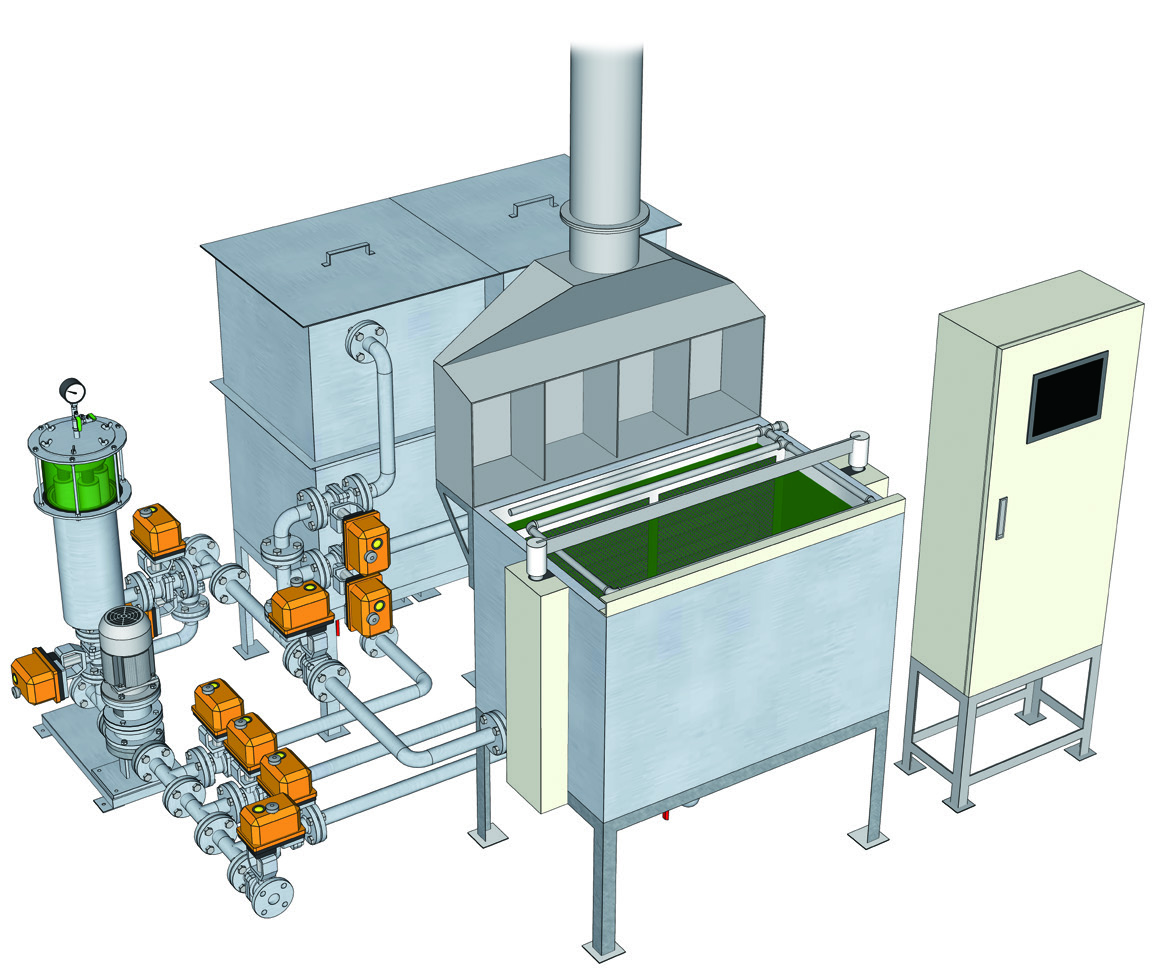
Core equipment configured around bath management
Circulation and purification, condition management and operation preparation each have corresponding equipment functions.
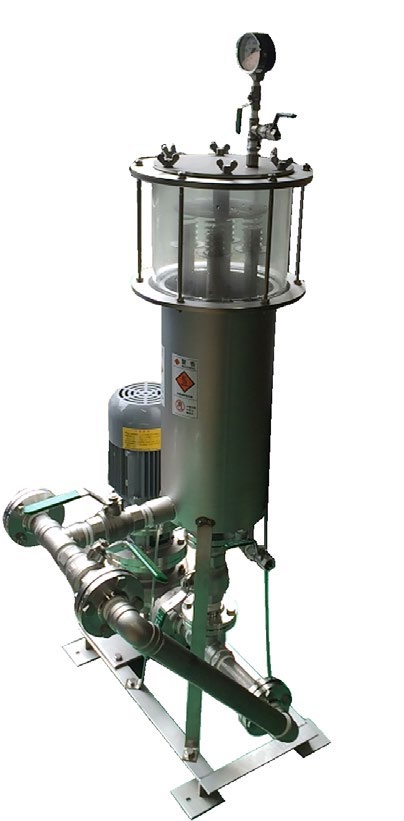
01 / FILTRATION · SFVP
Circulation filter pump
Continuous circulation keeps the bath clean.
Used for bath circulation in high-temperature electroless nickel operations, filtering foreign matter, dust and other impurities to help maintain bath cleanliness and plating quality.
- Circulation and filtration at the same timeImpurities are continuously removed while the bath circulates.
- Observable without disassemblyCheck filtration status through the transparent filter housing for easy operation and maintenance.
- Dedicated anti-deposition structureDesigned for electroless nickel processes, with a dedicated structure to suppress plating deposition.
- Stainless steel constructionEquipment listed in the product catalog uses all-stainless-steel construction with a special dry seal.
SFVP series standard specification reference
Compare flow rate, filtration area and motor power by tank capacity.
Swipe left and right to see full parameters →
| Model | Flow rate¹ L/min | Applicable tank capacity L | Filtration area m² | Motor power kW |
|---|---|---|---|---|
| SFVP-I | 60(80) | 100–500 | 0.65 | 0.75 |
| SFVP-II | 90(110) | 500–1,000 | 1.30 | 0.75 |
| SFVP-III | 130(160) | 1,000–1,500 | 2.60 | 1.5 |
| SFVP-IV | 260(300) | 1,500–3,000 | 3.90 | 2.2 |
¹ Flow rates keep the bracketed notation of the original data; the applicable conditions of the two sets of values are not stated and must be confirmed when selecting. The standard motor power supply is 200 V, three-phase; on-site power configuration must be checked separately.
See connections & weight
| Model | Inlet / outlet | Weight |
|---|---|---|
| SFVP-I | 32A / 20A | 80 kg |
| SFVP-II | 32A / 25A | 100 kg |
| SFVP-III | 40A / 32A | 125 kg |
| SFVP-IV | 50A / 40A | 150 kg |
Larger tanks: the data also lists a high-capacity configuration for tanks up to 5,000 L; specific processes and solutions are confirmed separately. For nitric acid transfer, medium conditions and equipment configuration must be confirmed.
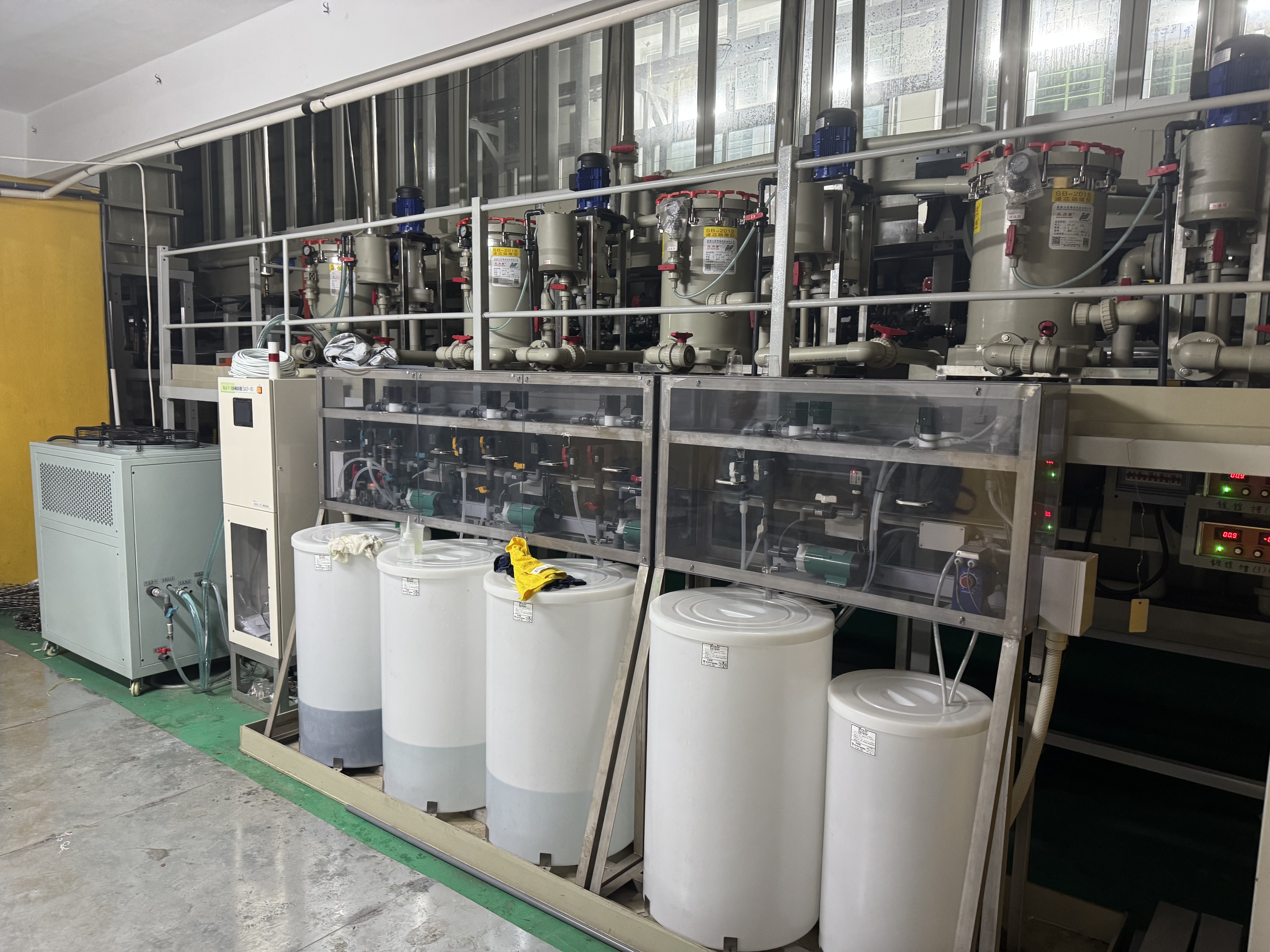
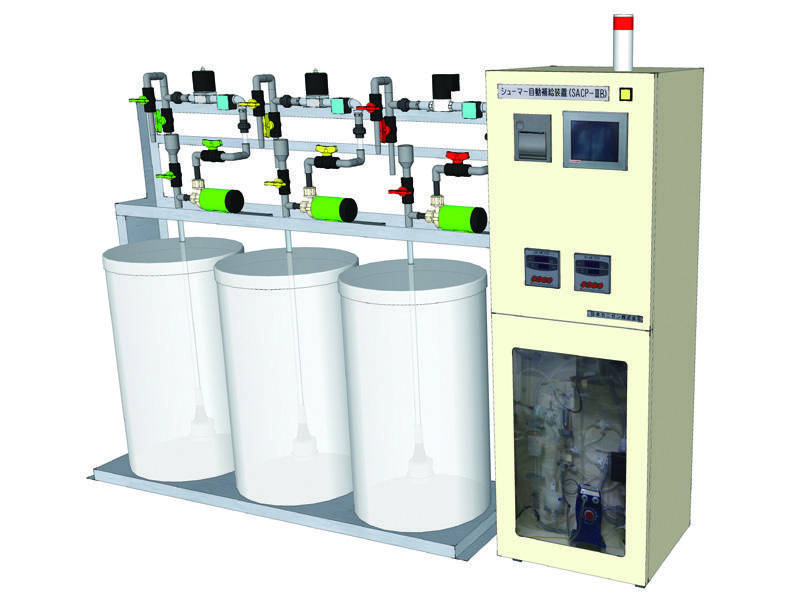
02 / ANALYSIS & REPLENISHMENT · SACP
Automatic analysis & compensation unit
Linking bath condition with replenishment management.
Manages, controls and automatically replenishes based on bath concentration, pH and temperature, supporting bath condition management during production.
- Flowmeter compensationReplenishment controlled by flowmeters.
- Operating records keptSupports printing and recording of operating data, alarm data and setpoints.
- Expandable on demandOptional automatic pH correction and data transfer to an indoor computer.
03 / AUTOMATION
Automatic make-up & nitric acid passivation system
From tank preparation to make-up and heating, linking each operation step.
Automatic valves and a control system bring tank nitric acid passivation, make-up and bath heating under automated management, reducing manual valve operation. With on-site IoT applications, operating status can be visualized to reduce human error.
Completes tank passivation in preparation for subsequent operations.
Linked to the make-up step by automatic control.
Bath heating is prepared before operation.
Tanks and auxiliary equipment working together
The plating tank performs plating; the nitric acid tank serves tank passivation; the spare tank temporarily holds the bath during cleaning and passivation.
| Item | Reference configuration | Function & use |
|---|---|---|
| Plating tank | SUS316 / SUS304 stainless steel; boat-bottom or R-type tank bottom, mirror-polished interior | Plating space configured to the workpieces and production conditions |
| Nitric acid tank & spare tank | SUS316 / SUS304 stainless steel, capacity and piping configured per process | Used respectively for plating tank passivation and for temporarily holding the bath during maintenance |
| Heating & agitation | Indirect heating via steam pipes; with air agitation piping | Meets bath heating and agitation needs |
| Temperature & level management | Temperature controller, level regulator | Supports bath temperature and level management |
| Other auxiliary equipment | Rocking device, constant-voltage device to prevent deposition, etc. | Optional according to workpiece and process requirements |
Expand to see tank design reference parameters
| Item | Catalog reference value | Corresponding location or condition |
|---|---|---|
| Separating metal mesh | 100–150 mesh SUS metal mesh | Between plating tank and heating tank |
| Heating steam pressure | 0.15–0.20 MPa | For steam heating |
| Freeboard above liquid level | 120–150 mm | From bath level to tank top |
The above are tank design references, not fixed specifications for every unit. Tank dimensions, capacity and specific design conditions must be confirmed with the actual process.
Equipment selection starts with production conditions
Clarifying the following helps discuss a standalone configuration, existing line upgrade or supporting system.
Bath & chemicals
Bath volume, chemical system, operating temperature, and current replenishment and bath change methods.
Workpieces & capacity
Workpiece material, dimensions, loading method, batch rhythm and expected throughput.
Site utilities
Available space, tank layout, piping routes, and water, power, steam and exhaust conditions.
Automation goals
Specific needs for filtration, automatic replenishment, make-up and passivation, operating records or data transfer.
Standard pump specifications are in the table above; filtration accuracy, replenishment accuracy, dimensions and actual supply configuration are confirmed per equipment and project plan.
Hand your requirements to AUTRA engineers
Provide the substrate, target performance and quantity, or your existing tanks and production conditions, and an engineer will confirm the applicable solution.