Processing customers, start here
Reduce droplet spreading and adhesion
Surface hydrophobicity is evaluated by metrics such as contact angle.
Contact angle must state the liquid, temperature, droplet volume and time of measurement. Surface hydrophobicity does not equal waterproofing or sealing of the whole part; actual wear, thickness and cleaning conditions should also be considered.
Tell our engineers your requirements
Enter substrate, quantity and performance targets; if you don't know the specific metrics, you can describe the problem you face.
Detailed test data · expand test conditions, historical data and interpretation
Conclusions first
Same historical test group: Ni-P 56°, PTFE specimen 1 103°, specimen 2 115°, specimen 3 117°.
The larger the contact angle, the less easily the surface is wetted by water under the same conditions.
Contact angle is not a waterproof sealing grade; industrial parts also require verification of thickness, wear resistance and performance after use.
Test conditions
Contact angle test | sessile drop method
- Standard / equipment
- DM-501
- Medium
- Pure water, droplet volume 1 μL
- Load
- Not applicable; droplet rests naturally
- Counterpart
- Not applicable; pure water contacts the coating surface
- Heat treatment
- 300°C heat treatment
Measured 10 s after dropping. Specimens are Ni-P electroless coating and PTFE composite coating historical specimens 1, 2 and 3; each value is only for comparison within this group.
Pure water contact angle · same-group historical records
On mobile, swipe the chart left/right; tap a chart to open the large image.
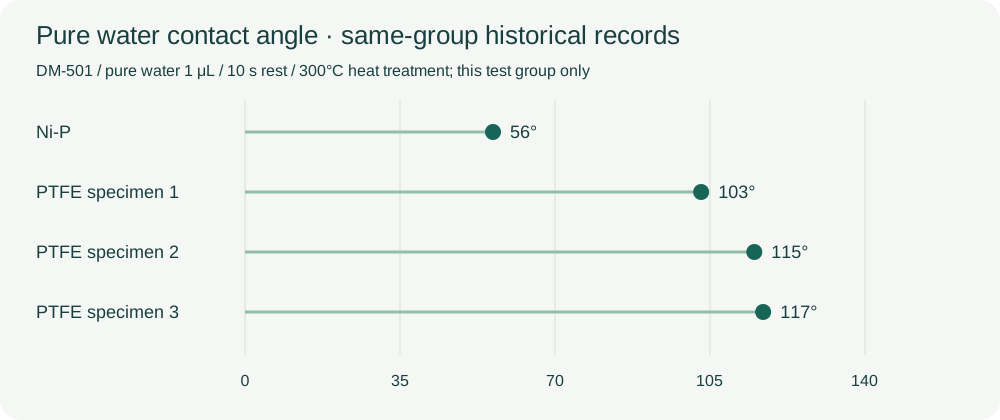
The four values come from the results table in the data, all at 300°C heat treatment, 1 μL pure water and 10 s settling. The 2° difference between specimens 2 and 3 cannot be taken to indicate significantly different industrial performance, nor as a guarantee for any workpiece.
Horizontal axis: °. Each point corresponds to a record in the original data table below; see the test data on the same page for applicable conditions.
Data & interpretation
Pure water contact angle | same historical test conditions
The table scrolls horizontally; the first column keeps the comparison items.
| Coating | Contact angle (°) | How to read |
|---|---|---|
| Ni-P | 56 | More easily wetted by water in this group |
| PTFE specimen 1 | 103 | More hydrophobic than Ni-P |
| PTFE specimen 2 | 115 | Larger contact angle in this group |
| PTFE specimen 3 | 117 | Highest recorded value in this group |
The four values come from the results table in the data, all at 300°C heat treatment, 1 μL pure water and 10 s settling. The 2° difference between specimens 2 and 3 cannot be taken to indicate significantly different industrial performance, nor as a guarantee for any workpiece.
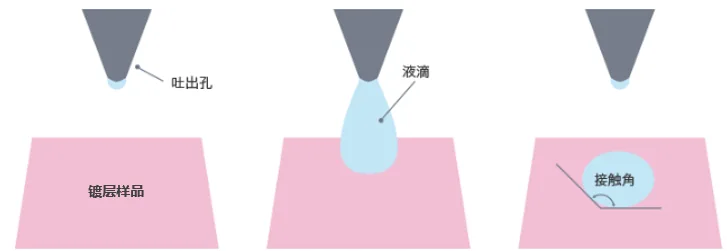
The diagram has no quantitative axes or scale bar; contact angle unit is °.
View full-size image ↗Test charts & test conditions
View charts, methods and conditions test by test. Vector charts can be clicked to enlarge; each data group applies only to the corresponding specimens and test conditions.
PTFE composite coating vs. PTFE coating: 2 μL contact angle comparison
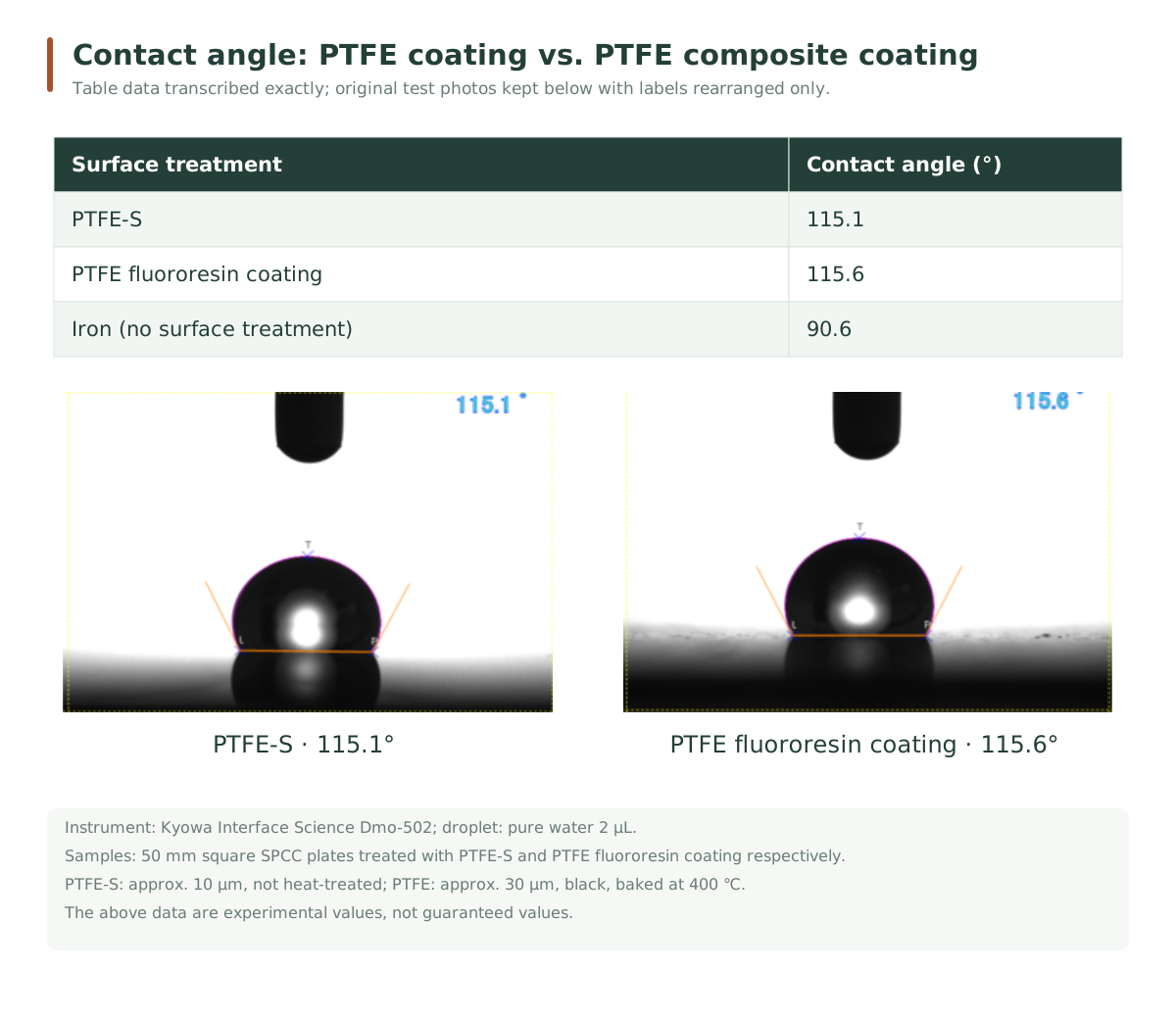
Test method & conditions
- Test instrument
- Kyowa Interface Science Dmo-502 (as labeled in source)
- Droplet
- Pure water 2 μL
- Substrate
- 50 × 50 mm SPCC plate; untreated iron plate as control
- PTFE-S composite coating
- approx. 10 μm; not heat-treated
- PTFE fluororesin coating
- approx. 30 μm; black; baked at 400 ℃
Japanese factory test values, not guaranteed values. PTFE-S is the source’s S-series composite coating; this group and the existing 1 μL, 300 ℃, 10 s contact angle test are kept separately.
Source
Selection advice & data boundaries
Please also confirm the contact media, operating temperature, coating thickness, cleaning method and allowable wear. The contact angle of water cannot directly represent the wettability of oil or other liquids.
When long-term hydrophobicity is required, contact angle should be remeasured after actual wear, cleaning and temperature cycling; waterproof sealing or leakage requirements need separate verification.