Processing customers, start here
Describe the effect the part needs to achieve; engineers determine the coating and process based on substrate, structure and quantity. You don't need to choose a chemical model yourself.
Tell our engineers your requirements
Enter substrate, quantity and performance targets; if you don't know the specific metrics, you can describe the problem you face.
Detailed test data · expand test conditions, historical data and interpretation
Conclusions first
The following is a candidate solution matrix, not a final process specification.
First state the main failure problem, then check substrate, dimensions and heat-treatment limits.
When multiple properties are needed at once, set priorities and agree on specimen acceptance.
Test conditions
For a specific workpiece evaluation, state the material, operating environment and acceptance requirements; read the test conditions separately for each data group on this page.
Data & interpretation
Operating condition → candidate coating → product data
The table scrolls horizontally; the first column keeps the comparison items.
| Main operating condition | Candidate coating | Confirm first | Product data |
|---|---|---|---|
| Corrosion resistance, humid environments | Mid-/high-P Ni-P | Media, thickness, heat treatment and evaluation method | Ni-P process selection overview ↗ |
| Abrasive wear | Ni-P + SiC、Ni-P-B | Abrasive, counterpart, load, whether heat treatment is allowed | SiC composite electroless nickel ↗ Electroless Ni-P-B plating ↗ |
| Dry sliding, low-oil motion | PTFE composite electroless plating, BN composite plating | Counterpart, speed, contact pressure | Electroless Nickel-PTFE | PTFE composite electroless plating ↗ Boron nitride composite coating ↗ |
| Oil-lubricated sliding | Ni-P-B, PTFE composite electroless plating (verify per conditions) | Oil type, frequency, temperature and wear mechanism | Electroless Ni-P-B plating ↗ Electroless Nickel-PTFE | PTFE composite electroless plating ↗ |
| Mold release, non-stick | PTFE composite electroless plating | Molding material, temperature, cleaning and compliance documents | Electroless Nickel-PTFE | PTFE composite electroless plating ↗ |
| Surface hydrophobicity | PTFE composite electroless plating | Contact media, contact angle and performance after wear | Electroless Nickel-PTFE | PTFE composite electroless plating ↗ |
| Low reflection | Post-plating blackening system; chemical black coating | Wavelength, angle of incidence and reflectance |
Recommendations in the table indicate product directions to discuss with engineers first; they do not mean all grades and structures are suitable. Final model, thickness, heat treatment and specifications are subject to drawing evaluation, specimen verification and the quotation.
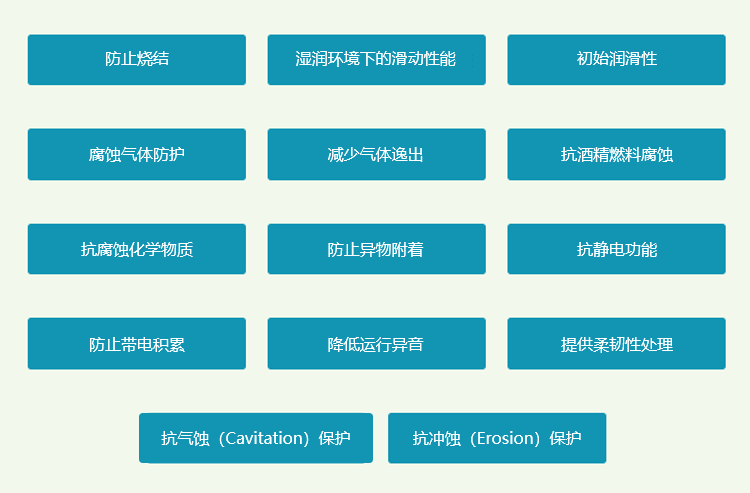
Function category illustration without quantitative axes; terms are read according to this site's selection matrix and are not test results.
View full-size image ↗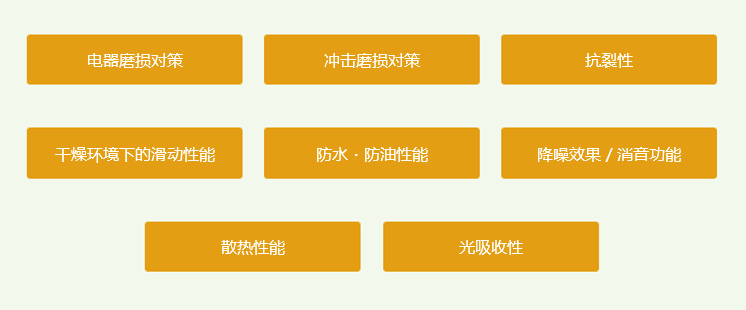
Function category illustration without quantitative axes; terms are read according to this site's selection matrix and are not test results.
View full-size image ↗Test charts & test conditions
View charts, methods and conditions test by test. Vector charts can be clicked to enlarge; each data group applies only to the corresponding specimens and test conditions.
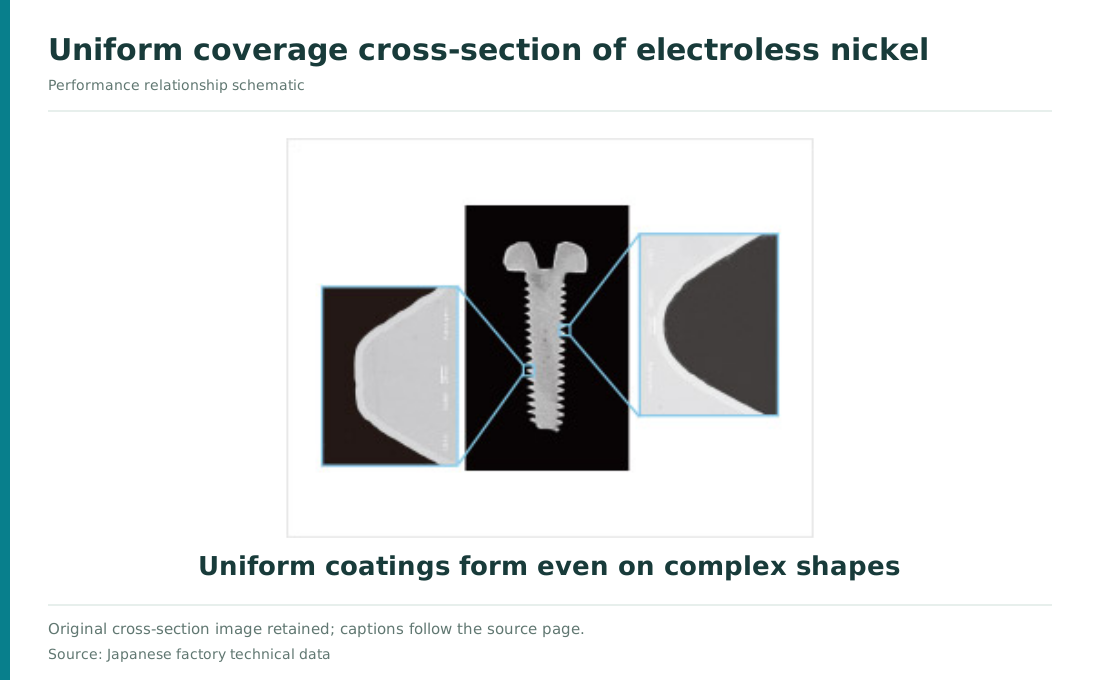
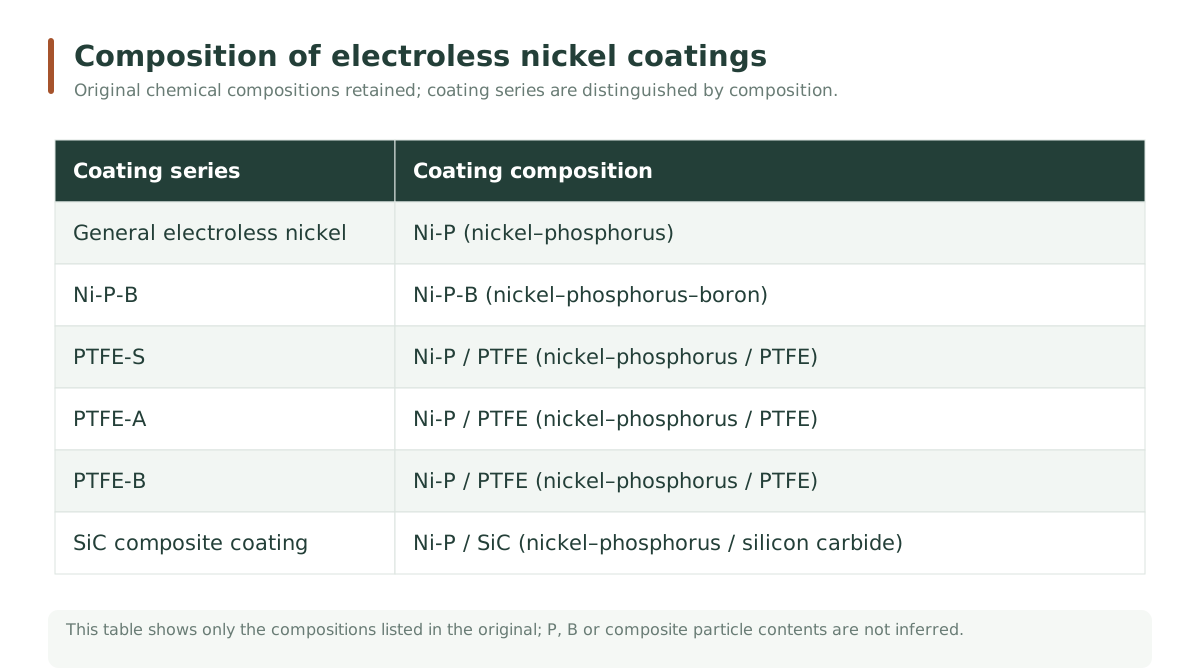
Coating composition & uniform coverage
Test method & conditions
- Nature of data
- Cross-section notes & composition index
- Series name
- PTFE-S / A / B denote the source’s three composite coating series
- Test standard
- This group is illustrative data with no unified performance test standard
The cross-section images and composition table illustrate structure and process systems; no thickness tolerance or particle content guarantee is given on this basis.
Selection reference: electroless nickel vs. hard anodizing
| Electroless nickel plating | Hard anodizing | |
|---|---|---|
| Dimensional accuracy | ◎ | △ |
| Insulation | × | ◎ |
| Applicable substrates | All aluminum materials | Mainly A5056, A5052 materials |
Test method & conditions
- Nature of data
- Rough comparison from source
This table is a selection reference; applicable aluminum alloys, heat-treatment condition and acceptance conditions must be confirmed for the specific workpiece.
Source
Selection reference: electroless nickel vs. hard chrome
| Electroless nickel plating | Hard chrome coating | |
|---|---|---|
| Plating method | Electroless plating via chemical reaction | Electroplating |
| Coating thickness uniformity | Excellent (also suitable for complex shapes) | Local thickness differences may occur |
| Corrosion resistance | Excellent | Excellent |
| Wear resistance | Excellent | Very excellent |
| Cost | Relatively high | Some processes are lower cost, but this varies with the process steps |
Test method & conditions
- Nature of data
- Rough comparison from source, not a unified test under identical conditions
The source’s comparison of the two processes in wear resistance, uniformity and cost is retained; actual specifications and cost are confirmed by workpiece and process.
Source
Choose candidate coatings by function
| Functional requirement for electroless plating | Performance overview | Main recommended electroless coatings |
|---|---|---|
| Rust prevention, corrosion resistance | Rust prevention, anti-corrosion and corrosion resistance against moisture, sulfurizing atmospheres, oxidizing atmospheres, salt, etc. | General electroless nickel coating, PTFE composite coating, SiC composite coating, Ni-P-B coating |
| Wear resistance | Resistance to wear, including wear resistance brought by high hardness or low friction coefficient. | Ni-P-B coating, SiC composite coating, PTFE composite coating, Ni-P-B coating |
| Lubricity | The property of sliding easily, achievable through low friction coefficient, oil retention or good running-in. | PTFE composite coating, Ni-P-B coating, SiC composite coating |
| Dimensional accuracy | Properties required by precision machine parts and electronic parts, expressed as thickness 10μm±1μm, ±10%, etc.; some parts are specified by flatness. | All electroless coatings |
| Build-up repair | For dimensional compensation; wear resistance, corrosion resistance and machinability are usually required at the same time. | General electroless nickel coating |
| Mold release | A property required by molds, closely related to non-stick. | PTFE composite coating, Ni-P-B coating |
| Low friction | Also called easy sliding; closely related to wear resistance and lubricity. | Ni-P-B coating, PTFE composite coating, SiC composite coating |
| Post-machinability | The property of being easy to machine after plating. | Ni-P-B coating, general electroless nickel coating |
| Electrical conductivity | The property of allowing current to pass easily. | All electroless coatings |
| Magnetism | A property required by magnetic recording media, magnets, magnetic cores, etc., covering static properties (coercivity, squareness ratio) and dynamic properties (memory characteristics); specific requirements vary by application. | General electroless nickel coating, PTFE composite coating |
| Low contact resistance | Low resistance at electrical contact areas, sometimes called switching performance together with high hardness and wear resistance. Sliding contacts such as rotary switches and connectors place particular emphasis on wear resistance. | Ni-P-B coating, general electroless nickel coating, SiC composite coating, PTFE composite coating |
| Resistive properties | Properties required for a resistor. Some special electroless nickel coatings can set the resistance value via coating thickness. | General electroless nickel coating, Ni-P-B coating |
| Anti-reflection | Also called anti-glare; the property of suppressing light reflection and glare, often achieved by blackening or forming a fine-particle matte surface. | Black electroless coating, post-plating blackened electroless nickel coating |
| Weather resistance | The property of protecting UV-sensitive plastics, rubber and coatings from UV degradation. ※Refers to polymer materials such as plastics and paints resisting deformation, discoloration and degradation in outdoor use. | Black electroless coating, post-plating blackened electroless nickel coating |
| Heat resistance | The property of coating properties (hardness, wear resistance, corrosion resistance, etc.) not degrading easily at high temperature. | Ni-P-B coating, general electroless nickel coating, SiC composite coating |
| Chemical resistance | Resistance to corrosion by chemicals, organic acids, etc. | General electroless nickel coating, PTFE composite coating, SiC composite coating, Ni-P-B coating |
| Solderability | The property of being easy to solder, also called solder wettability; an important property in electrical, electronic and mechanical fields. | Ni-P-B coating, general electroless nickel coating |
| Bondability | A property needed in semiconductor part manufacturing: ease of bonding to gold or aluminum wire by thermocompression or ultrasonic bonding. Solder bondability and similar properties are related. | Ni-P-B coating, general electroless nickel coating |
| Non-stick | Often used synonymously with mold release; closely related to easy sliding and low friction coefficient. | PTFE composite coating, Ni-P-B coating |
Test method & conditions
- Nature of data
- Qualitative recommendations for mechanical, electrical, photothermal and chemical properties
- Reference
- Source cites “Electroplating Guide ’06”
- Test standard
- This table has no unified comparison test standard
The recommendation matrix is for finding evaluation directions; the example precision and performance descriptions in the table must be confirmed for the specific workpiece.
Source
Selection advice & data boundaries
For corrosion resistance, discuss Ni-P first; for wear, SiC or Ni-P-B; for sliding, mold release and hydrophobicity, PTFE composite electroless plating; for low reflection, post-plating blackening systems. Every direction must be rechecked against actual conditions.
On drawings, please mark no-plating areas, critical mating dimensions, subsequent assembly and heat-treatment limits. Performance goals that are still unclear can be described as actual problems such as seizing, material sticking, rusting or dimensional wear.
Please provide load, counterpart, media and temperature together with the drawing; engineers choose the verification method based on the conditions.